

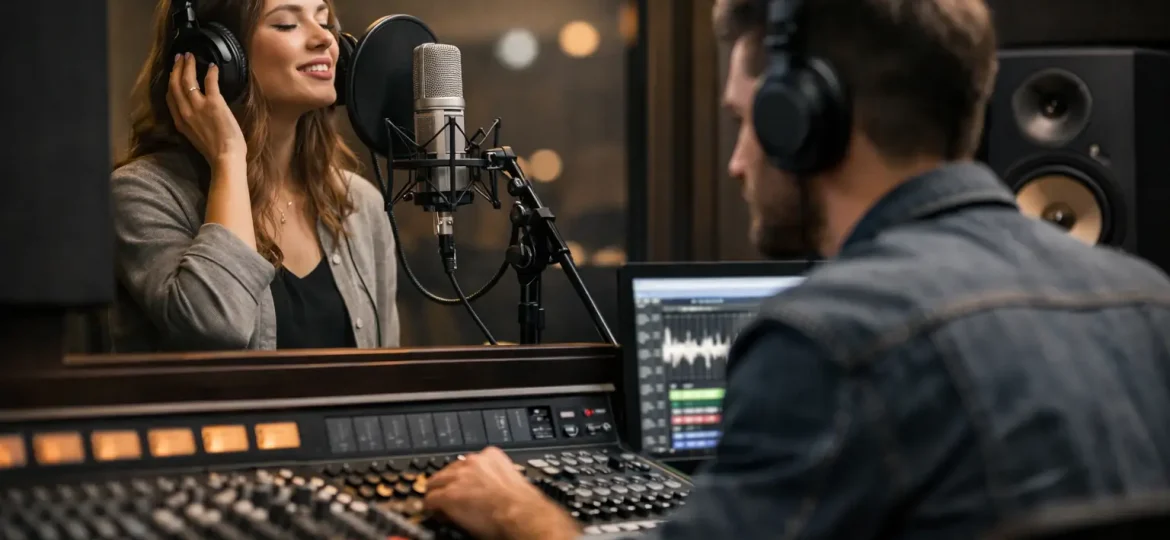
A vocal can be perfectly in tune and still leave a song flat. Maybe the verse does not feel personal enough. Maybe the chorus arrives without lift. Maybe the singer has the right tone, but the record has no clear point of view. Vocal production is what closes that gap between a good vocal take and a performance people remember.
For independent artists, the vocal is usually the center of the record. Listeners may not know what microphone was used or how the drums were compressed, but they will recognize whether the voice feels believable, confident, and connected to the song. Getting there takes more than turning on a mic and adding effects after the fact.
What Vocal Production Actually Does
Vocal production is the creative and technical process of shaping how a singer delivers a song and how that performance lives inside the finished track. It includes coaching the performance, choosing a recording approach, capturing multiple takes, selecting the strongest lines, refining pitch and timing where needed, and building the right layers around the lead.
A producer listens for the details that can change the emotional impact of a lyric. Is the singer rushing a line because the words are difficult? Does a held note need more air, more power, or less vibrato? Would the chorus feel larger with a double, a harmony, or a different vocal tone entirely? Those choices are not corrections for their own sake. They are arrangement decisions.
The goal is not to make every voice sound the same. Some records need a polished pop lead with clean tuning, tight doubles, and a bright high end. Others need grit, breath, and a little imperfection because that is where the emotion lives. Good vocal production respects the artist’s identity while making sure the performance translates through speakers, headphones, cars, and social clips.
Start With the Song, Not the Plug-Ins
The strongest vocal sessions begin before recording. A singer should know the lyric, but knowing the lyric is different from knowing what each line is supposed to do. Before the first take, talk through the song’s story. Who is the singer speaking to? Where does the emotion shift? Which phrase needs to land hardest?
Decide the point of view
A love song can be tender, frustrated, relieved, playful, or heartbroken. The words may stay the same, but the delivery changes completely. If the artist has not chosen a point of view, the takes often sound inconsistent. One line may be intimate while the next sounds like it belongs in a stadium anthem.
Reference tracks can help, especially for newer artists. They are not a blueprint to copy. They give the team a shared language for discussing energy, vocal tone, space, and arrangement. A reference can tell you whether the vocal should sit close and dry, float in a wide atmosphere, or cut through an aggressive beat.
Make the performance recordable
Preparation also means being realistic about the key, melody, and phrasing. A chorus that sits at the edge of a singer’s range may work once, but it can become strained after several passes. Lowering the key slightly can create a stronger recording than forcing a note that never sounds comfortable.
That does not mean every challenge should be removed. Sometimes a little strain is the sound of urgency. The difference is whether the strain serves the lyric or simply limits the performance. A hands-on producer can help make that call in the room, before hours are spent trying to repair a problem later.
Recording the Lead Vocal
A comfortable singer gives a better performance. That starts with practical details: the right microphone for the voice, a useful headphone mix, enough volume to feel the track, and enough vocal level to hear phrasing clearly. If the singer is fighting the headphones or guessing where the beat sits, the session loses momentum fast.
It also helps to record more than one complete pass. The first take may have the most natural feeling. The second may have better diction. A later pass may contain one chorus that suddenly opens up. Capturing options gives the production team material to work with without asking the artist to recreate an accidental great moment.
Coaching should be specific and manageable. Instead of saying, sing it with more feeling, try a direction the singer can act on: pull back on the first half of the verse, treat this line like a confession, or hit the final word as if it is the answer to the whole song. Clear direction keeps the artist engaged and protects their confidence.
There is a trade-off here. Recording too many takes can make a singer tired and cause the performance to become careful rather than alive. Recording too few can leave no room to build a clean, expressive final vocal. The right number depends on the artist, the genre, and how demanding the melody is.
Building a Vocal Production That Fits the Track
Once the lead is captured, the production starts taking shape. Comping combines the best moments from multiple takes into one complete performance. A good comp should sound like one singer delivering one thought, not a collection of chopped-up lines. Consistent tone, breath placement, and emotion matter as much as choosing the cleanest note.
Pitch correction and timing adjustment can polish a vocal, but they work best as support tools. Light tuning can keep a strong take focused. Heavy tuning can be a deliberate style choice in modern pop, hip-hop, and electronic music. What matters is intent. If the effect distracts from the song or erases a singer’s character, it is doing too much.
Doubles and harmonies add scale, but they need purpose. A doubled lead can make a chorus feel wider and more urgent. Harmonies can lift a key lyric, answer the lead, or create movement near the end of a section. When every line has stacked vocals, however, the track can lose contrast. A quiet verse needs room to feel quiet before the chorus earns its impact.
Ad-libs deserve the same attention. The right ad-lib can become the hook listeners repeat. The wrong one can clutter the lyric. Record several ideas, then keep the moments that strengthen the lead instead of competing with it.
Mixing Is Where the Vocal Finds Its Place
A great recorded vocal still needs to fit the production. EQ can remove distracting buildup or add presence. Compression can control level changes so words stay audible. De-essing can soften harsh sibilance. Reverb and delay can create depth, width, and movement.
None of those tools has a fixed setting that works for every song. A dense track may need a more direct vocal with careful compression and short effects. A sparse acoustic song may benefit from more natural dynamics and a larger sense of space. The question is always the same: can the listener hear the lyric and feel the performance?
Automation often makes the final difference. A word at the end of a line may need a small level lift. A delay throw on one phrase can create drama without washing out the entire record. The best vocal mixes feel intentional, even when the listener cannot identify why.
Plan for the Release, Not Just the Session
If a song will have a music video, performance clip, or promotional content, think about the visual presentation while the record is being finished. The final arrangement affects what needs to be performed on camera, where key moments happen, and which lyrics deserve visual emphasis. Planning audio and video together saves time and gives the release a more unified feel.
At True Songs Productions, that collaborative approach matters because artists often need more than studio time. They need another set of experienced ears, practical production decisions, and a finished sound that represents where they want to go next.
Bring a clear idea, even if it is only a voice memo and a lyric sheet. Then stay open to the moments that happen in the room. The right vocal production does not replace your voice – it helps listeners hear exactly why it matters.
