

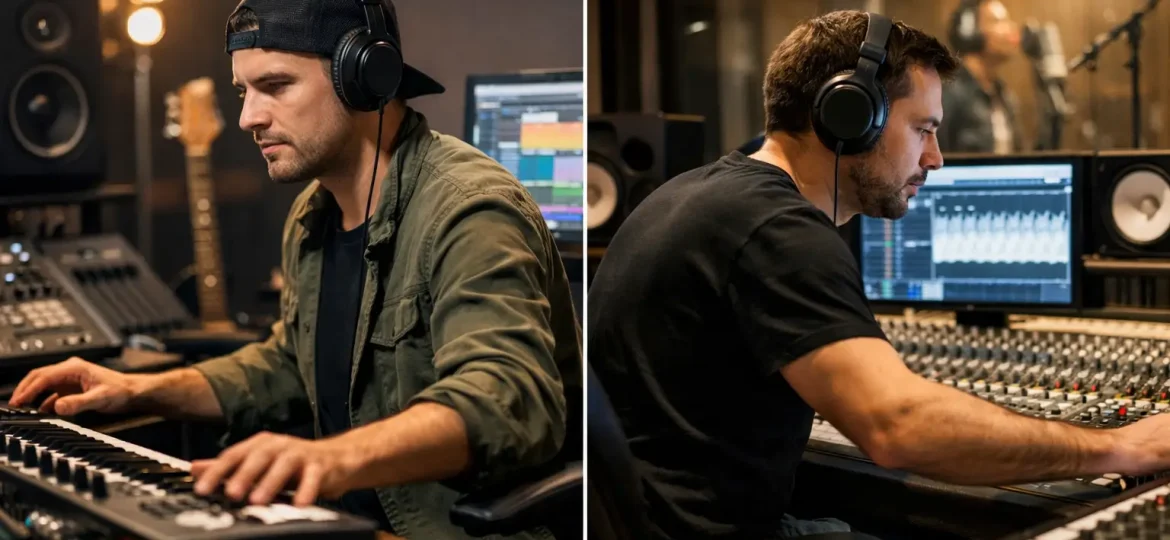
You have a strong hook, a phone demo, and a clear feeling for what the song should say. Then you book studio time and face a common question: music producer vs audio engineer – who do you actually need? The answer can shape not only how your session runs, but whether your finished record sounds like a polished version of your idea or simply a cleaner recording of it.
These roles often work side by side, and one person may handle both in a smaller studio. Still, they solve different problems. A producer helps make the song work. An audio engineer helps make the recording sound right. Knowing the difference helps you book the right support, use your studio time wisely, and walk out with more than a rough take.
Music Producer vs Audio Engineer: The Core Difference
A music producer focuses on the creative direction of the song. They listen for the big picture: the arrangement, the energy, the vocal delivery, the instrumental choices, and the emotional impact. Their job is not just to ask whether the vocal is in tune. It is to ask whether that vocal makes the listener believe the lyric.
An audio engineer focuses on the technical process of capturing and shaping sound. They set up microphones, manage levels, operate the recording system, reduce noise, edit performances, and build a mix that translates across speakers, headphones, cars, and phones. They are responsible for making sure the creative choices come through clearly.
Think of it this way: if a song feels unfinished because the chorus needs to hit harder, the verse needs fewer instruments, or the vocal needs more personality, that is producer territory. If the vocal is distorted, buried under the track, too harsh, or inconsistent from line to line, an engineer can solve those issues.
The roles overlap because great records need both creative judgment and technical skill. But the starting point is different. The producer asks, “What should this song become?” The engineer asks, “What do we need to do to capture and present it properly?”
What a Music Producer Does for Your Song
A producer is a creative partner, not just someone who presses record and gives opinions. Depending on the project, they may help develop a basic voice memo into a complete record or bring focus to a song that is already close to finished.
They develop the arrangement
An arrangement is the plan for how a song moves. It determines when the beat enters, when instruments pull back, how long the intro lasts, and how the chorus earns its impact. A producer may recommend cutting an eight-bar intro to four bars, adding a pre-chorus, changing the key, or saving the biggest vocal harmony for the final chorus.
Those choices can make a major difference. A strong lyric can lose listeners if it takes too long to get moving. On the other hand, a song with a simple lyric can become memorable when the arrangement gives it contrast and momentum.
They coach the performance
The right take is rarely just the one with the fewest mistakes. A producer may ask for a more conversational verse, a more controlled vocal in the chorus, or a second take with less vibrato and more grit. They can hear when an artist is technically correct but emotionally holding back.
This is especially valuable for newer artists. Recording can feel exposing, and it is easy to get stuck chasing perfect notes. A producer helps you keep the goal in sight: a performance that connects.
They help make creative decisions
Should the song have live guitar or programmed keys? Does the beat need to feel more spacious? Is the feature helping the record, or distracting from the story? A producer helps answer questions like these based on the genre, the artist’s identity, and the audience you want to reach.
That does not mean the producer takes over your music. A good producer listens first. They help sharpen your vision, challenge weak ideas when needed, and keep the project moving when too many options start slowing it down.
They can build the production itself
Some producers write chords, program drums, play instruments, create tracks, and contribute melodies or hooks. Others work mainly as creative directors while musicians and beatmakers supply the musical pieces. It depends on the producer and the project.
If you are bringing only lyrics and a melody, look for production support that includes songwriting and track development. If you already have a finished beat and arranged song, you may only need targeted producer input during vocals and final revisions.
What an Audio Engineer Does in the Studio
An audio engineer turns a session into usable, professional-quality audio. They work with equipment, but their value is much more than knowing which button to push. A skilled engineer understands how technical choices affect the listener’s experience.
They capture a clean, confident recording
Before the first take, an engineer chooses and positions the microphone, sets the recording level, checks the headphones, and makes sure the room is working for the voice or instrument. Small details matter. The wrong microphone position can exaggerate harsh consonants. Poor gain staging can create distortion that no mix can fully repair.
During the session, they keep an ear on issues that can interrupt momentum later, such as background noise, clipping, mouth clicks, or a headphone mix that is making the singer perform tentatively.
They edit without removing the life
Most modern recordings involve editing. An engineer may clean up breaths, tighten timing, comp vocal takes, correct small pitch issues, and remove noises between phrases. The goal is not to make every performance sound robotic. It is to preserve the human character while removing distractions.
There is a trade-off here. Too little editing can leave a release sounding unprepared. Too much editing can flatten the personality that made the performance worth recording. A good engineer knows where to clean up and where to leave the edge intact.
They mix the record
Mixing is where individual tracks become one finished listening experience. The engineer balances vocals and instruments, shapes tone with EQ, controls dynamics with compression, uses effects such as reverb and delay, and creates width and depth.
A mix should serve the song. A dense hip-hop vocal may need to stay upfront and direct. A singer-songwriter track may benefit from more room and natural detail. The best mix is not always the loudest or most effect-heavy. It is the one that makes the song communicate.
When You Need a Producer, an Engineer, or Both
If your song is written, arranged, rehearsed, and built around a finished instrumental, an audio engineer may be all you need. You can arrive ready to record, focus on performance, and rely on the engineer to capture, edit, and mix your material professionally.
If you have a lyric, melody, chord progression, unfinished beat, or a feeling you cannot quite translate into a full song, production support is likely the better first step. A producer can help you make the creative decisions before expensive studio hours are spent recording parts that may not stay in the final arrangement.
For many independent artists, both roles are the smartest choice. You need a producer’s ears while developing the record and an engineer’s discipline while recording and mixing it. That combination is also helpful when you want to move from a finished song to a music video. The clearer the audio vision, the easier it is to create visuals that match the energy and story of the track.
At True Songs Productions, that hands-on approach means artists can get more than room time. They can work with a musician and songwriter who understands how a raw idea becomes a record worth sharing, while still giving the technical side of the session the attention it deserves.
Questions to Ask Before You Book Studio Time
Start by being honest about where the song stands. Can you perform it from beginning to end? Is the beat final? Do you know the key? Are you looking for a clean recording, or do you need someone to help decide what the record should sound like?
Also ask what is included in the session. Recording, editing, mixing, beat creation, vocal tuning, and songwriting support are separate services in many studios. Clear expectations protect your budget and prevent the frustrating moment when you realize the session created a good vocal take but not a finished release.
Bring references, but use them the right way. Two or three songs that communicate the vocal tone, drum energy, or overall mood you want are more useful than saying you want something “radio-ready.” References give your producer and engineer a common language without forcing your song to copy someone else’s work.
The best session begins with a simple conversation about your goal. Bring the strongest version of your idea, stay open to useful direction, and give the right people room to help you make it sound like you meant it.
