

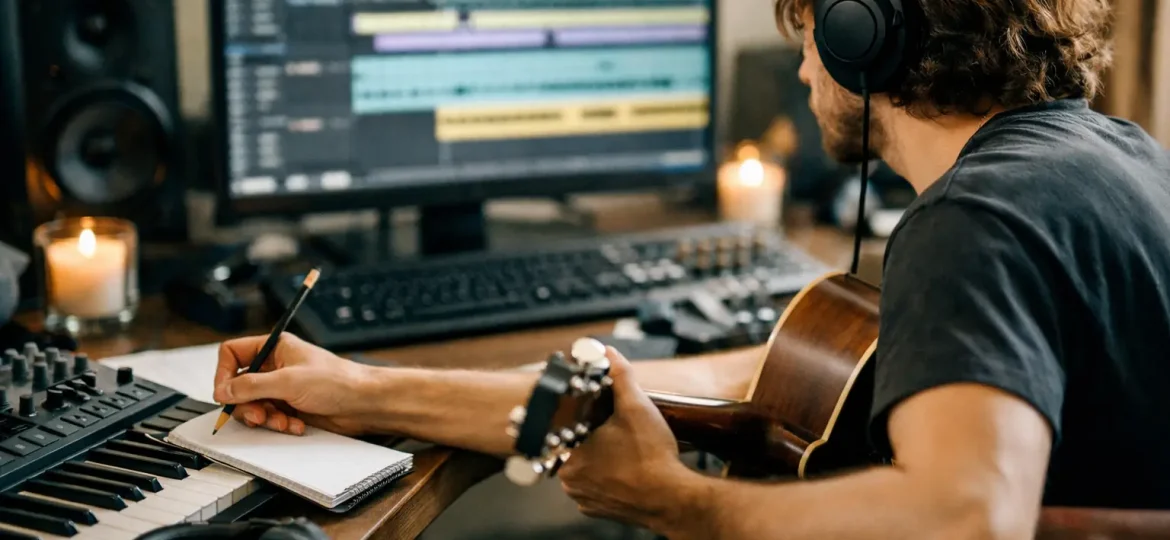
A strong song rarely arrives at the studio fully formed. It might start as a voice memo recorded in a parked car, a chorus written after midnight, or a guitar part that feels good but has no clear structure yet. This indie artist song development example shows how a promising idea can become a finished record with a sound, performance, and visual direction that feel intentional.
Picture an independent Houston singer-songwriter named Maya. She brings in a 58-second phone recording: acoustic guitar, a melody, and one line that stands out – “I kept the light on for you.” The emotion is there, but the song is not ready to record. The verse repeats the same idea twice, the chorus arrives too late, and the guitar rhythm leaves little space for a vocal to lead.
That is not a problem. That is the beginning of development.
Indie Artist Song Development Example: Starting With the Core Idea
The first job is not choosing a microphone or opening a recording session. It is identifying what the listener should feel by the end of the song. Maya’s lyric suggests waiting, disappointment, and the moment someone finally decides to stop waiting. That emotional turn becomes the song’s center.
Instead of adding more words immediately, the producer asks a few practical questions. Is this song an apology, a breakup song, or a declaration of independence? Is Maya singing to a specific person or to herself? Does the final chorus need to feel defeated or free?
Maya decides the song is about taking her power back. That decision changes the writing. The early verse can stay intimate and uncertain, but the chorus needs a line that moves forward. “I kept the light on for you” becomes the setup. The hook becomes, “Now I know the way out.”
A great chorus does not have to explain everything. It needs to give the listener a phrase they can remember and sing back. In this case, the new line also provides a clear emotional lift. The song has somewhere to go.
Build the Song Before You Build the Production
Maya’s original idea is verse, verse, chorus. That can work, but it gives the song little contrast. The team tests a more focused layout: verse, pre-chorus, chorus, verse, pre-chorus, chorus, bridge, final chorus.
The pre-chorus is only four lines. Its role is to raise tension, both lyrically and musically, so the chorus feels earned. The chords move upward. The guitar pattern becomes simpler. Maya holds the last word of each line slightly longer.
This is where many independent artists lose time. They try to solve a songwriting problem with more production. Extra instruments can make a rough demo sound larger, but they cannot make an unclear chorus land. If a song does not connect with one vocal and one instrument, it may need more writing before it needs more layers.
That does not mean every song must work as an acoustic performance. Some songs depend on a beat, a bass line, or a specific vocal treatment. The point is to make sure the foundation is doing its job. In Maya’s case, playing the new structure on acoustic guitar makes the emotional rise obvious. The song now has a beginning, a turn, and a release.
Choose a Production Direction That Serves the Lyric
Maya initially imagines a full rock arrangement with loud drums and distorted guitars. It is a valid idea, but it competes with the vulnerable opening lyric. After testing the song at a few tempos, she and the producer settle on a modern indie-pop direction: warm electric piano, a tight kick and snare pattern, muted guitar texture, bass that grows in the second chorus, and a bigger final section.
The arrangement is built around contrast. The first verse stays light, with electric piano and a restrained vocal. A small percussion element enters in the pre-chorus. The first chorus adds bass and a wider guitar part, but it still holds back. The second verse introduces a subtle synth texture. By the final chorus, the drums open up, harmony vocals stack behind the hook, and the arrangement finally reaches the size the lyric has been promising.
This gradual build helps the listener stay engaged. It also gives Maya a clear performance map. She does not have to sing every line at maximum intensity. She can start close and conversational, then let the emotion grow naturally.
Production choices should fit the artist, not chase whatever sound is popular that week. A polished pop arrangement may be wrong for a raw folk lyric. A stripped-down record may not serve an artist whose strength is high-energy performance. The best direction is the one that makes the song believable in that artist’s voice.
Tempo, key, and comfort matter
Maya’s phone memo is in a key that works on guitar but pushes her vocal too high in the chorus. Rather than forcing the take, the song is moved down one whole step. Her voice immediately sounds fuller, and the higher notes carry more confidence instead of strain.
A small tempo adjustment makes a difference too. At 84 beats per minute, the first draft feels heavy. At 90, the chorus moves without losing the reflective mood. These are simple decisions, but they affect every recording that comes next.
Record for a Real Performance, Not a Perfectly Flat One
Once the arrangement is ready, Maya records guide vocals first. These are not necessarily final takes. They help establish phrasing, breath placement, and the emotional shape of each section.
Then she records lead vocals in complete passes, rather than trying to capture one line at a time from the start. A full pass preserves momentum. It often reveals natural moments that would disappear in a heavily pieced-together performance: a slight crack before the bridge, a breath that makes a line sound honest, or a softer final word that lets the track breathe.
After several full takes, the strongest moments can be selected and cleaned up. Pitch correction may be used lightly where needed, but it should support the vocal, not erase its character. The goal is a performance that sounds confident and release-ready while still sounding like Maya.
Harmony vocals arrive in the choruses and bridge. Rather than stacking everything everywhere, the producer saves the biggest harmonies for “Now I know the way out.” That choice makes the hook feel larger without crowding the lyric.
Instrument recording follows the same principle. Every part needs a purpose. The bass reinforces the movement. The guitar adds rhythm and texture. The piano anchors the harmony. If a part does not improve the feeling or the groove, it may be better left out.
Make Space for the Mix and the Listener
A mix is not just a technical polish pass. It is where the track is organized so listeners hear what matters most at each moment.
For Maya’s song, the lead vocal stays clearly in front because the lyric carries the story. The low end is controlled so the kick and bass feel present without becoming muddy. Reverb gives the chorus width, while the verse remains more intimate. A touch of delay on the final vocal phrase creates a sense of space after the song’s biggest statement.
Reference tracks can help here, especially when discussing vocal level, drum weight, or overall brightness. They should be used as a conversation tool, not a blueprint. Maya does not need to become another artist. She needs a record that holds up next to professional releases while keeping her own identity intact.
Before mastering, listen in more than one place. Studio monitors reveal detail. Headphones reveal vocal edits and effects. A car test can expose low-end issues. A phone speaker shows whether the hook and lead vocal still come through when the listener is not hearing every frequency.
Give the Finished Song a Visual Life
For independent artists, the release is stronger when the audio and visuals share the same story. Maya’s song is about leaving the light on, then choosing the way out. That creates a simple music video concept: an apartment at night, practical lamps in different rooms, and a final scene where daylight replaces artificial light.
The video does not need a huge cast or complicated plot. It needs a clear mood, strong performance footage, and visual details that connect to the lyric. A few planned shots can also become vertical clips for social media, lyric snippets, cover-art support, and release announcements.
This is one advantage of working with a creative partner who understands both sound and video. The song can be produced with the visual performance in mind, and the video can reflect the actual emotional arc of the record instead of feeling like an unrelated add-on.
At True Songs Productions, the goal is to help artists make those decisions with confidence, from the first rough idea through recording and visual content. You do not need to arrive with every answer. You need a song worth developing and a team that will help you make it sound and look like you meant it.
